
Stuck in a Billboard

Billboards!
marketing case studies of… you guessed it, billboards
by Jacob Rudy Dybeck
The Man in the Billboard
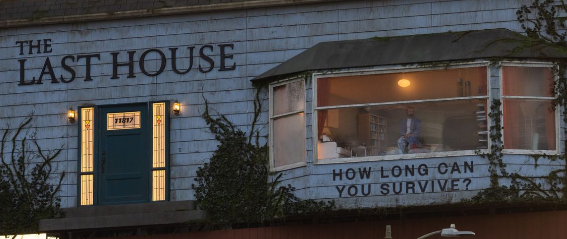
You are in bumper to bumper traffic down Sunset Boulevard accompanied by the excruciating summer heat. You look around at the billboards advertising new movies and products and you lock eyes with a man. You shake your head, you must be hallucinating, there can’t be a man inside that billboard 30 feet in the air. Your gaze returns to the billboard, and the man is staring back at you with binoculars holding a sign that says, “stuck in here”. Either you are delirious from the heat, or there is actually a man stuck in a billboard! Is this some tweaker that climbed up there? A graffiti artist with no way down? No, it is a Netflix advertisement for their new movie.

Actor, comedian, and producer Nathan Shoop spent several days inside a furnished living room built into a billboard, beginning August 6 and ending on August 8th (Lee). The air-conditioned room had an exterior with a door, chimney, and ivy making it look like a real house with a resident. NBC Los Angeles reports on Shoop’s activities, “The man was also seen using binoculars to take in the sights. On Friday morning, he could be seen wearing a red robe, stretching, brushing his teeth and using the whiteboard and marker to write messages” (Lloyd).
For those three days Shoop was in the billboard he would eat cereal, watch traffic with binoculars, wave to commuters, and reply to people with a dry-erase whiteboard; all with the movie title “The Last House” and accompanying text “How long can you survive?” being displayed around him (Famous Campaigns).
Why It Got Attention
Obviously a man living above a busy street is extremely obscure and bound to draw attention, but that is not the sole purpose of marketing. Marketing must represent a brand/product, and tell some sort of story to have a long lasting impact and convert into the desirable K.P.I (key performance indicator). This got attention as it is a stunt that not only references a key theme in the movie it is advertising, but it physically embodies it.
“The Last House” is a full length science fiction thriller. Stephan Lee, a writer for Netflix's Tudum, describes the premise as centering on “a family of four who suddenly find their home sealed off from the outside world and must figure out how to survive” (Lee). This premise and theme of isolation is not just referenced literally or metaphorically; but physically and where a massive number of commuters can perceive it. In marketing there are several categories of media being advertised, we’ll investigate each one to see why this project got the attention it did.

Paid Media
Paid media is any placement a brand pays for directly, purchased and controlled outright. Netflix hasn't publicly disclosed the campaign's budget, so instead we will rely on industry benchmarks to offer a rough estimate. The billboard's location alone carries a large cost, comparable large-format physical billboard installations typically rent for $10,000 to $25,000 per month in prime Los Angeles locations (Queiroz). Given that Netflix has maintained a presence at this specific site before, it's likely this cost was already built into an existing lease rather than a one time booking. The physical build is a separate expense entirely; experiential activations with custom fabrication in major markets typically run $75,000 to $250,000+ (Barnastics). Given the scale of this build, including a fully furnished living room constructed into an existing billboard, three days of live staffing, and full media coordination, it's reasonable to estimate production costs fell toward the higher end of that range.
Owned Media
Owned media is any channel a brand controls; its own accounts, its own site, its own words all without having to pay. Netflix supported the stunt across multiple owned channels. The brand posted more than once on X and ran a similarly timed post on Instagram, suggesting a coordinated, cross-platform push (Netflix). Netflix continued promoting “The Last House” more broadly throughout August, however content specifically referencing the billboard stunt was concentrated around the days it was actually up. After the stunt was complete, Netflix extended the story further through Tudum, its official companion site, publishing a full interview with performer Nathan Shoop (Lee).
Earned Media
Paid media bought the billboard and owned media announced it; earned media is what happened outside of Netflix's control with third party reporting. News sources covered the story quickly. NBC Los Angeles sent a crew out to the billboard while the performer was still living inside it, treating it as a local news story (Lloyd). Coverage extended past news broadcasts as within days the stunt was written up by entertainment and lifestyle outlets as well as marketing specific trade publications covering it as a case study in experiential advertising (Famous Campaigns). Having coverage by local news, entertainment press, and trade industry all within the same week is a clear sign of the billboard’s success in gaining attention. None of this coverage was purchased, and all of it extended the campaign's reach beyond what the billboard's physical location alone could have delivered.
Shared Media
Earned media consists of third-party publications and coverage such as news reports; shared media on the other hand looks at the audience specifically and their level of engagement and resharing. Shared media showed up in two main ways for “The Last House” billboard. First, people engaged with Netflix's own posts; commenting, sharing, and reposting. The second way this campaign generated shared media was by the people who encountered the billboard in person. Social media users created and shared entirely original content taken from the street or from cars stuck in traffic. Although engagement with Netflix’s original post is beneficial, the level of success in this scenario was uplifted more so by those posting with no involvement with Netflix at all.
Who Made It?

The billboard was created by the agency Extra Credit, which described the project on their website in the form of a brief, “Communicate a story where 1) a family are trapped inside 2) indefinitely 3) with no explanation... 4) and do it in the fastest, noisiest way possible” (Extra Credit, "The Last House"). Extra Credit is a Los Angeles based studio specializing in what they call "turn-keying live experiences and interactive campaigns through collaboration, creative production and experiential content creation." (Extra Credit, "About").
In an untraditional fashion they construct physical, real world creations, handling everything from creative direction and production logistics to spatial design and capturing content. Their client roster includes major names like Netflix, eBay, Spotify, Cigna, CÎROC, Yuga Labs, and WWE, among others (Extra Credit, "Library"). This isn't Extra Credit's first time working with Netflix as the agency has also produced "Party Pack," a Netflix Games street-gaming activation, and the "Crane Kick Challenge," a fan photo-op built for the final season of "Cobra Kai" (Extra Credit, "Party Pack"; Extra Credit, "Cobra Kai”). Not only does this agency work with recognizable brands, they have ongoing collaborations with them. Their work on this billboard highlights their unique and out of the box thinking that generates results.
Did It Actually Work? A Look at the Numbers
Did the billboard actually deliver on Netflix’s desired KPIs? A marketing analytics team wouldn't just look at how much attention a campaign got, they'd separate the noise from the results.
On generating awareness, the numbers are hard to argue with. A handful of X and Instagram posts, and one physically built billboard produced coverage from local news, entertainment outlets, marketing trade publications, and the general public within the same week. The stunt gained an immense amount of earned and shared media, in a sense saving Netflix money from paying to be seen to that extent. However grand you perceive this accomplishment, does not mean anything unless the call to action worked.
The business outcome tells a more complicated story. "The Last House" debuted at No. 1 on Netflix's Top 10 movie list with 27.5 million views, marking the year's fifth-best opening for a Netflix original film, and giving Chernin Entertainment two of the platform's top original releases of the year (Kroll). At the same time, the film's critic score opened at 43 percent and slid to 29 percent within three days of release, with audiences rating it at 28 percent (Orosa). Millions of people pressed play, but few people had good things to say about the film.
A billboard’s job isn't to make people like a movie, it's to make them press play. So regardless of the reviews, the billboard did exactly what it was meant to. Netflix hasn't released internal completion rates or retention data for the film, so whether it got Netflix the audience it wanted is a number only Netflix has. No matter what that data may look like, the agency Extra Credit proved it could get people's attention.
Applauding Extra Credit
Extra Credit didn't stumble into a viral moment; they built one on purpose. We may not know if the billboard got Netflix an influx of lifetime subscribers, but I can assume they are pleased with the variety of attention it received. Even a month after the man in the billboard left his temporary home, here I am still talking about it. The campaign got me to watch the movie, what I thought of the film is irrelevant, but I do plan to keep an eye on Extra Credit and see what other amazing projects they create in the future.
I am left wondering if this form of marketing billboards will evolve, and if so where will it go? I can imagine an Amazon Prime Mr. Beast special being marketed by someone having to live in a billboard for a month to get a large sum of money. But who knows, what do you think?
Works Cited
Barnastics. "Experiential Marketing Activation Cost in 2026: Budget Guide." Barnastics, 22
Extra Credit. "About." Extra Credit, weareextracredit.com/about/.
---. "Cobra Kai." weareextracredit.com/cobra-kai-crane-kick-challenge.
---. "The Last House." weareextracredit.com/the-last-house-the-man-in-the-
billboard.
---. "Library." weareextracredit.com/library.
---. "Party Pack." weareextracredit.com/netflix-games-party-pack.
Famous Campaigns. "Netflix Traps a Man in a Billboard above Sunset Boulevard." Famous
Campaigns, 9 Aug. 2026, www.famouscampaigns.com/2026/08/netflix-traps-a-man-in-a-billboard-above-sunset-
Kroll, Justin. "'The Last House' Debuts At No. 1 On Netflix Top 10." Deadline, 11 Aug. 2026,
Lee, Stephan. "Meet the Man Who Lived Inside a Billboard for The Last House." Tudum,
Netflix, 14 Aug. 2026, www.netflix.com/tudum/articles/the-last-house-billboard-man-interview.
Lloyd, Jonathan. "Why a Man Is Living in a Billboard on West Hollywood's Sunset
Boulevard." NBC Los Angeles, 6 Aug. 2026, www.nbclosangeles.com/news/local/man-living-west-hollwood-
Netflix [@netflix]. Posts related to The Last House billboard campaign. X and Instagram,
Aug. 2026.
Orosa, Roberto. "Netflix's 'The Last House' Puts Man in a Billboard." DesignRush, 10 Aug.
Queiroz, Rodolfo. "The Complete Updated 2025 Guide to Billboards in Los Angeles." Dash
Two, 29 Mar. 2025, dashtwo.com/blog/guide-to-billboards-in-la/.
Comments